Showing posts with label baking. Show all posts

Thursday, 2 June 2011

Baking experiments part 2 - with videos!

So in part 1 I discovered that for optimum strength you should turn your oven off at the end of the baking cycle and leave your polymer clay pieces to cool down slowly in the cooling oven. This was just an initial test to see if the set up was going to work before I made lots of samples with more complicated curing, and something I had always been curious about. I was happy that the test worked and set about making more samples (got a blister from the extruder - am thinking it might be time to look at those walnut hollow ones....).

For these tests I chose to cool all my samples at room temperature, although I knew they would be stronger if I let them cool slowly. It was easier to control the curing, meaning I didn't have to reheat the oven for each curing and also the testing would be quicker if the specimens weren't as strong There will be a third round of tests where I search for the real optimum curing based on what I have learnt so far. As before samples are all made from very well conditioned scrap Kato polymer clay. They are extruded cylinders and are approximately 10 cm long and 6mm in diameter. You may note, looking at the results below, that I only repeated each test twice this time. I made three samples each time but as the results were reasonably close and there were a lot to test I decided that two was enough! I haven't got round to polishing the samples yet, to see how shine is affected by cure time/temp - that's a job for another day!

Cure time tests
I  tried curing samples for different amounts of time. The temperature for all the samples was 150°C and they were removed from the oven at the end of their cure time to cool at room temperature. The samples cured for 40 min had some longitudinal cracks on them when they were removed from the oven, however there was no sign of the cracks when they had cooled.

Cure time results
10 min -breaking point weight -  501g, 481g
20 min - 2035g*, 1986g*
40 min - 1900g*, 1935g*
*weight of water when specimen bent out of jig.

The weights given for the 20 and 40 min cure samples are not particularly relevant as these samples didn't break, they curved so much they slipped through the test rig. You can see this happening and the test set up in the video below.

Video showing the test set up and how the strong samples bent and slipped out of test jig.

Just managed to photograph this specimen as it started slipping through - see how bent it is!

Having looked at the samples I conclude that for 6mm thick pieces 20 minutes curing is sufficient for  strength and perhaps 40 min is too much due to the presence of the cracks on the warm sample, although this wasn't proved to make them weaker.

Oven temperature tests
All samples had 10 min in the oven at a set temperature that was verified with an oven thermometer, they were then removed and cooled at room temperature.


Oven temp results
140°C (~280F)- breaking point weight -440g, 380g
150°C (~300F) - breaking point weight -501g, 481g
160°C (~320F)- breaking point weight -1076g, 900g
170°C (~338F)- breaking point weight -1567g, 1498g

As you can see that change from 150°C to 160°C and again to 170°C makes a significant increase in strength!

Here's a video of a 140°C sample so you can see how little it flexed before breaking, compared to the 150°C for 20 min sample  in the video above.

Video showing a test where the 140°C for 10 min cure specimen breaks without much bend


In a recent post on the Kato facebook page (31st March if you want to look back and find it, can't find a way to make a direct link to that post) Tony Aquino,  the technical director at Van Aken, who manufacture Kato polyclay, discussed curing temperatures (great timing thank you Tony!). He said that higher temperature of curing would mean stronger clay, my tests show this too.

Conclusion of my experiments so far

Increasing the cure temperature increased the strength of the sample significantly but the samples still all broke. Increasing the cure time meant that the samples were much stronger and held about  2kg, or 2 litres of water before they bent so much they slipped through the test jig.  That may be to do with the increased time allowing the temperature in centre of the specimen to reach the correct temperature or some other factor, I'm not sure.

 I would like to do some more tests looking at cure time against thickness of specimen so that I would know the ideal time for all thickness of clay. Next time I am bored I guess!

I will cure my next specimens at 160oC (320F) for 20 min, and leave them to cool in the oven as it cools down. This would seem to be the best way to cure 6mm thick Kato Polyclay  for optimum strength. I will test this and let you know the results.

This blog will soon be finding a new home, I do hope you'll move with me - I'll keep you posted

Have fun with your polymer clay
Cara

Sunday, 15 May 2011

Baking experiments part 1

In order to find out how best to make strong bracelets I have a series of experiments planned. The first thing I wanted to find out was if polymer clay is stronger if it's quenched, that is plunged into ice cold water straight from the oven. I've heard people say this makes it stronger, polish better and it will keep transparents more transparent. Well I'm using grey coloured scrap Kato clay so can't comment on the transparency but my findings were that it doesn't make clay stronger or polish better.

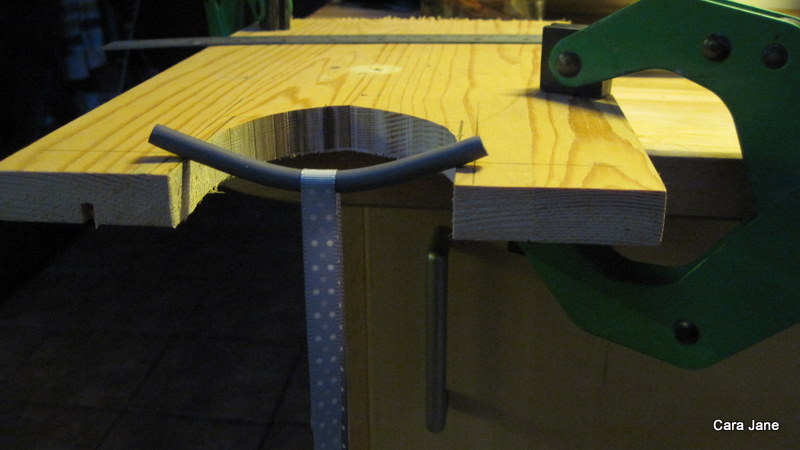
I wanted to know how strong polymer clay was when it was being bent so my clever engineer husband set up a test for me. I used to do similar work with composite materials for a living as a research materials scientist but I had big expensive machines and gauges to record what was happening (I've got a photo somewhere I will try and dig it out). My husband has also done similar work (we met at work) but is better at finding alternative ways to do things than I am, he's a real problem solver!


Here is one of my extruded rod samples, of extremely well conditioned Kato scrap clay. They are 10cm long and about 6mm in diameter. I chose to extrude them so I could be sure they were as similar as possible.


The sample is 'bridged'  over a gap. A loop of ribbon is passed over it and attached to an empty milk carton. Water is poured into the carton until the samples breaks and then we weighed how much water the sample had 'held'. My husband tried to poor the water into the bottle at a steady rate, he isn't holding the bottle just has his hand under it to catch it when the sample breaks so the water doesn't spill. We weighed the water in the bottle at the point that each sample broke.

One of the test pieces not long before it broke! As you can see it has bent quite a bit.

All the test pieces were baked at 150°C (verified with oven thermometer) for 10 min. At this point
three samples were taken out of the oven and left on the side to cool, I am calling these samples 'room temperature'. Three were plunged into ice water, I am calling these samples 'quenched' and three were left to cool in the oven which was turned off  and cooling down slowing, these are called 'slow cool' samples.

The results
'Quenched' samples breaking point weight - 485g, 673g, 772g
'Room temperature' breaking point weight -501g, 481g, 759g
'Slow cool' samples breaking point weight- 1069g, 1274g, 1522g

As you can see although there is a fair bit of variation in the results without a doubt the 'slow cool' samples were significantly stronger in flexure (being bent). Watching the test they obviously bent a lot more than the other 2 types of samples before snapping. I'll try and video one of the next ones so you can see a test in action.

I then polished one part of each type of sample using my micromesh  cloths and counting the strokes, doing the same for each. The verdict on that is that there is no discernible difference in shine between them.

This test was with Kato clay, I am curious if it's true for other polymer clays but being as I don't use other brands I probably won't take the time to find out I'm afraid.

I am going to do two more tests one to see how the baking temperature effects the strength in flexure (bending) and shine and one to see how the baking time effects the strength in flexure and shine. I am pretty sure that the longer baking time will make them more shiny when polished as that is one of the reasons I currently bake for longer, it will be interesting to find out in a more controlled way though.

The results may be a while coming so in the meantime I would advise that if you want your clay strong, leave  it to cool down in the oven after turning it off when you have finished baking!